

Incunable, n. (ɪnˈkjuːnəb(ə)l/)
“A book printed with metal type, from the Gutenberg Bible (c.1455) to 1501”
Inside Incunables
Rosalie Engels | MA candidate, SOLAL
Helen Ling Liu | MLIS candidate (University of Toronto)
Melissa McAfee | Special Collections Librarian
Brittney Payer | MA candidate, History
D
id you know that the McLaughlin Library is home to a collection of books on witchcraft dating from the Early Modern Period? Among the older imprints in Archival & Special Collections are works published in the 17th century including Admirable Historie of the Possession and Conversion of a Penitent Woman, Seduced by a Magician That Made Her to Become a Witch by and The Question of Witchcraft Debated: Or, a Discourse Against Their Opinion That Affirm Witches, Considered and Enlarged by . These books were published at the beginning of a profound increase in witchcraft trials in Europe that occurred from the middle of the 17th century when secular courts began to add witchcraft trials to their dockets. Prior to then, witches were tried primarily by ecclesiastical courts and theories of witchcraft as heresy were in development. Soon after the beginning of printing by more works on witchcraft and demonology saw their way into print, bringing the topic of witchcraft more clearly into public view.

The well-known Malleus Maleficarum (“Hammer of the Witches”) by was instrumental in bolstering the witch panic and urged that witches be tried in secular courts. Just five years later, in 1492, a collection of Felix Hemmerlin’s works were in his Opuscula et Tractatus, which contains four separate treatises on spells, witches, demons, and exorcism. The text was edited by the humanist from Strasbourg, who was known for his satirical allegory . The Opuscula et Tractatus came at a time when the meanings of magic and the supernatural were being redefined, and so Hemmerlin’s ideas presented a side to medieval conceptions of witchcraft other than the Malleus Maleficarum. In his book, Hemmerlin offers a justification for the use of magic and includes a very different definition of the devil than was typically believed at the time.
was a Swiss Roman Catholic cleric, scholar, and church reform advocate. Like other authors of works on demonology and witchcraft of the 15th century and perhaps earlier, he wrote on a variety of other subjects, including the failed mission of Franciscan friars to proselytize inhabitants of the Canary Islands. Unlike many contemporary authors, Hemmerlin is surprisingly tolerant of witchcraft and even advocates for the use of certain spells, providing an interesting contrast to other works of the time (including works in our collection). It’s not clear exactly why Hemmerlin wrote this book, which was first published after his death, and there appears to be no translation of it into a modern language.
—
…in 1492, a collection of Felix Hemmerlin’s works were published in his Opuscula et Tractatus, which contains four separate treatises on spells, witches, demons, and exorcism.
Recently, a group of University of Guelph students accompanied Melissa McAfee, Special Collection Librarian, to the Toronto Antiquarian Book Fair where they were fortunate to be able to purchase a copy of Hemmerlin’s book. No copies exist of the book in Canada, although the lists 147 copies in libraries in Europe and the United States. Our hope is that students of Latin at the University of Guelph will avail themselves of this work and at some point translate it so that we can learn why it was written. Richard Griffin, a recent University of Guelph graduate with an MA in History, has already begun with a translation on an exorcism to be used on cattle — a very appropriate subject for the University of Guelph.
Hemmerlin’s Opuscula et Tractatus is the second incunable to be acquired by Archival & Special Collections. Incunables refer to the earliest printed books published during the first 50 years after . The first and oldest in our collection is the 1485 edition of the Quodlibet by .
Aquinas was a scholastic professor in 13th-century Paris, and he often undertook theological disputes in public, answering the objections of his colleagues and later disseminating them in manuscripts. The Quodlibet contains questions posed to Aquinas by academics as well as his responses. The twelve Quodlibets in our incunable deal with questions to a variety of subjects, such as angels, damnation, the divine nature of God, grace, and sin. Notable questions debated at the disputations Aquinas presided over included: “Can God restore a fallen virgin?”, “Can one sin by fasting too much?”, “Can a demon know our human thoughts?”, and “Is truth stronger than wine, kings and women?”
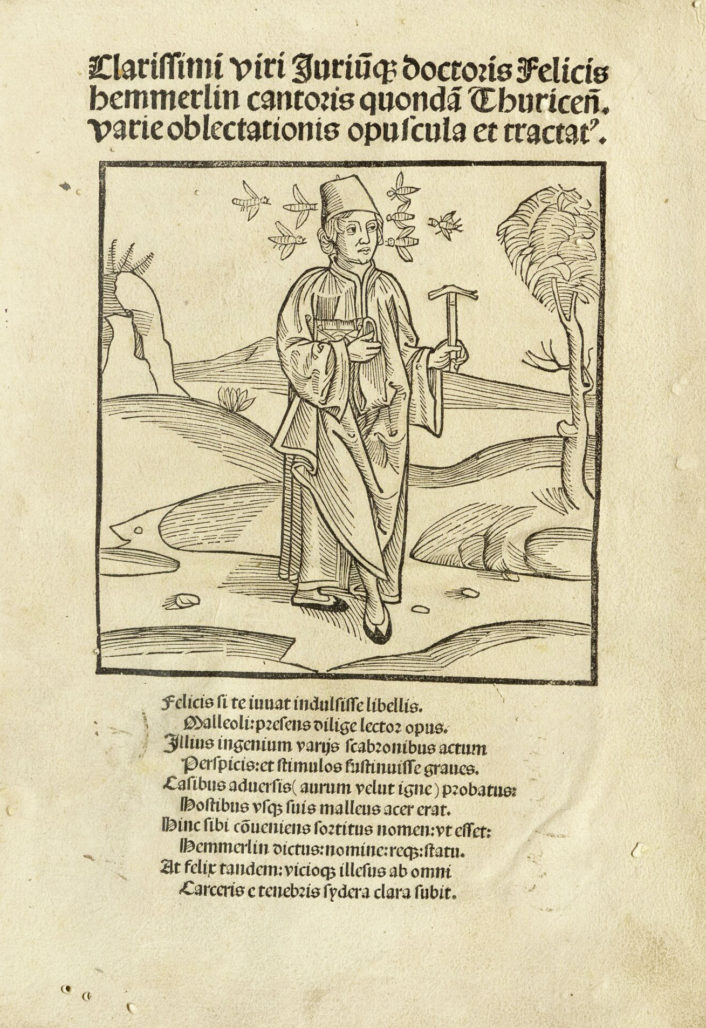
Incunables are also the first books printed in multiple copies using movable type. This innovation in book production marked the beginning of a new era in the dissemination of knowledge, as previous books were handwritten by scribes who made single, unique copies of texts. The Opuscula et Tractatus clearly showcases several features of early printed books. The text is printed in Latin in a gothic typeface, a font characterized by angular strokes and fusing of letterforms. An interesting feature on the first page of this book is a large portrait of the author whose head is encircled by swarming bees (see picture below).
The portrait was printed from a woodcut, a relief printing process in which a design was carved deeply into a block of wood and then inked for printing. Woodcut illustrations in printed books were especially popular in 15th-century Germany, where our incunable was printed, and are a feature that is largely credited with launching woodcuts as an art form in later centuries.
While incunables were printed rather than handwritten, elements remained from the manuscript tradition. Spaces were left for large initials at the beginnings of words for rubricated or decorated initials to be added later (see picture below).
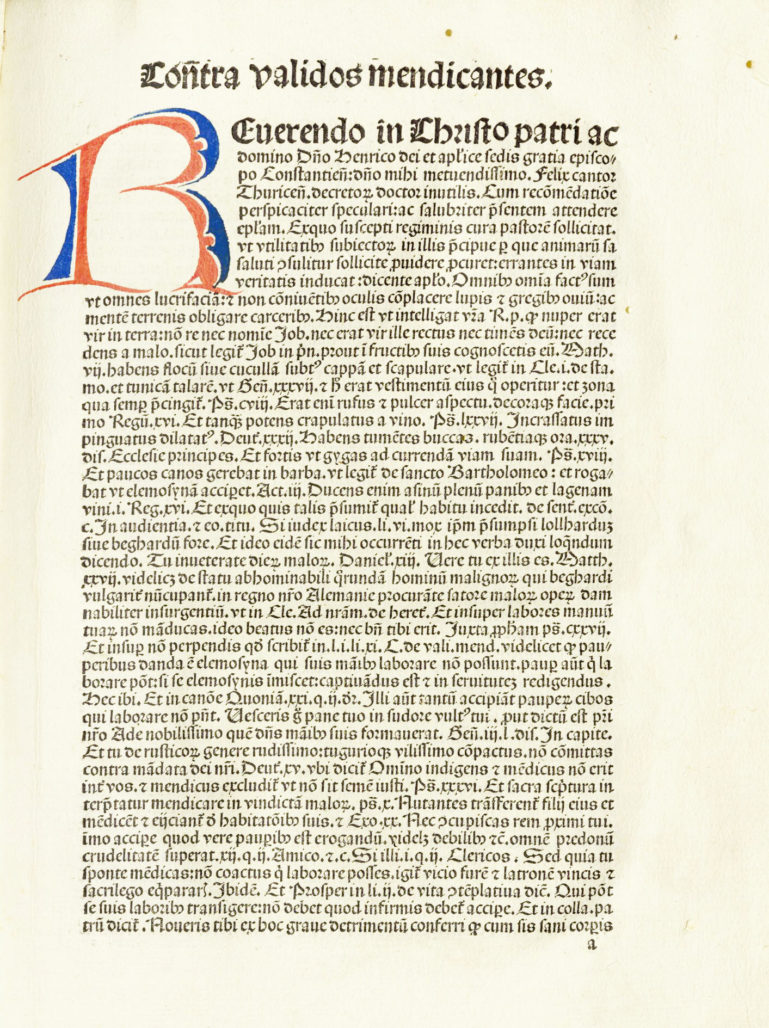
The original book would likely have been purchased unbound, at which time the purchaser would then have had to make arrangements to have the book bound. The letters at the bottom of the pages (A-Z and aa-gg), called “signatures,” instructed the binder on the order that the gatherings (groups of unbound leaves) should be sewn together. The hand-drawn letters and decorations found in incunables were just as exquisite as those found in manuscripts. Although the printed text was usually uniform across all copies of the print run, the rubrications and decorations were often unique. Comparisons with other digitized copies of Hemmerlin’s book show, for example, that some copies do not have the rubricated initials as ours does.
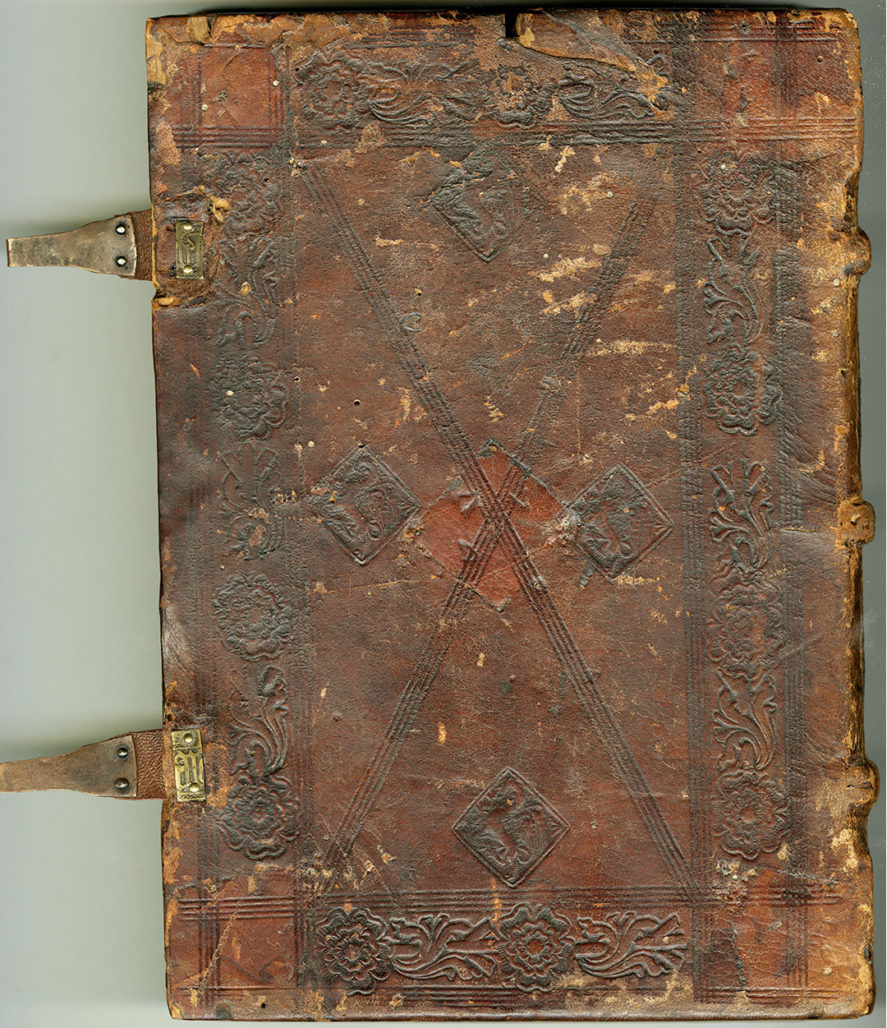
Our copy of the Opuscula et Tractatus is bound in contemporary, blind-stamped calf over wooden boards, with the original metal clasps and catches still intact, and shows evidence of having been chained (see picture above). Books of the Middle Ages were expensive and valuable possessions and were sometimes chained to a desk or a lectern to discourage thieves. The chained binding also indicates that this book was likely owned by a college or ecclesiastical institution. Of interest to the University of Guelph are a series of four stamped gryphons (although some might call them dragons) on the back cover.
Early books were hand-sewn onto supports, and this can be seen in the raised bands across the spine of the book forming thick ridges. In a few places, corrections appear to have been added by the printer who crossed out undesirable words, replacing them with revisions written by hand.
I
ncunables provide an interesting point of transition between medieval and early modern book production. The advent of printing allowed for the rise of the printed book, overtaking the written manuscript because of its efficiency and accessibility. Though, for many years the two coexisted. Features of manuscript production bled into printing, maintaining the earlier tradition well into succeeding centuries of book culture. Examples of this transition from medieval manuscripts to incunables will be on display for all to see in the exhibit gallery on the second floor of McLaughlin Library.
This exhibit, “Illuminating Life: Manuscript Pages of the Middle Ages,” is based on a loan of nine original manuscripts dating from the 13th to 15th centuries and is curated by University of Guelph graduate and undergraduate History students. The exhibit will be launched during the “From Parchment to Pixels” colloquium on medieval manuscripts featuring University of Guelph students and a keynote talk by distinguished medievalist Will Noel from Princeton University. This free event will take place on Mar. 12 from 1 to 5 p.m. in the Robert Whitelaw Conference Room (2nd floor, McLaughlin Library). Watch out for A&SC’s next article for details on the medieval manuscript exhibit.

Please visit www.theontarion.com/submit to find out how you can share your work with The Ontarion.