

photos by Alex Vialette
The five candidates for Central Students Association (CSA) Executive positions gathered in the University Center on Feb. 5, to speak about their platforms, why they should be elected, and to answer questions.
The candidates in attendance were Tyler Poirier, Nolan Polkinghorne, and Zoey Ross, who are all running for CSA President, as well as Sara Kuwatly, the candidate for Vice President Student Experience, and Horeen Hassan, the current Vice President External who is looking to secure a second term.
President of What?
The prevailing mood in the University Center was one of indifference, as students walked past the nearly-empty rows of seats arranged before the candidates.
“We have to work hard to make this a comfortable and safe place for folks, so they come out, they come to our events, and we remain approachable,” said Zoey Ross, a fourth-year Political Science and Theatre student and candidate for CSA President, when talking about the lack of engagement from students.
Ross, who was an executive member of the CSA in 2016 and has previously run for CSA president (though he withdrew his candidacy before coming to a vote), spoke about the importance of the CSA. Like all of the candidates, he expressed concern over the limited engagement from students. “We need to make [the CSA] more beneficial and approachable.”
This sentiment, though stated in different terms by each candidate, was the overarching theme of the forum.
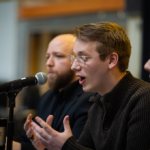
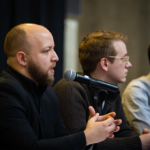
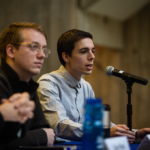
Students at the University of Guelph are, by and large, not involved with their CSA, and throughout the afternoon we heard candidates repeatedly asking why and speaking about what they would do as president to build up that student engagement.
“Guelph, the university, is a community, and the CSA is a central part of that community,” said Nolan Polkinghorne, a recent International Development Studies graduate and candidate for CSA President.
He expressed a concern that “the world we live in today,” is not particularly conducive to community environments. Given this, the CSA must work harder to strengthen its ties to student groups, and the students themselves.
“I want to put a human face on the CSA.” Polkinghorne, who presented himself on stage as easy-going and fun — several times he made small quips — to the point of being a little goofy, described a bubble separating student leadership from the students. “There’s a bubble that separates student leadership and engagement from the student body itself.”
He said that, as president, he would pop that bubble by focusing part of his time on connecting directly with students. He hopes to be able to use part of his week to “go and sit in Brass Taps,” he said, then emphasizing the need to listen directly to students. “I want to make sure my door is always open — and that students know that,” he said. “I want to be on the ground.”
“Democracy at the University of Guelph needs further participation and engagement,” said Criminal Justice and Public Policy student and candidate for CSA President, Tyler Poirier.
Poirier has been the Volunteer and Public Relations Coordinator for CSA’s SafeWalk program. He spoke about his experience working with the CSA and the need for increased accessibility across campus, both in terms of infrastructure and the ways that organizations such as the CSA directly interact with students.
When asked what a successful term as CSA president would look like, Poirier responded that success would equal “creating a more stable but also productive and representative Central Student Association.”

Do Students Care?
“No one really gives a shit, and that’s the problem,” said Polkinghorne, when the conversation shifted to why engagement is so low and what the candidates would do to change that.
Though blunt, this is a feeling we have heard expressed widely, in regard to more than just the CSA. Campus groups and organizations across the university, including The Ontarion, have seen low student engagement and participation in recent years. However, while not necessarily inaccurate, this statement fails to address the underlying question, why don’t people give a shit?
“I think students do give a shit,” said Ross in response. He described how the CSA has its limitations but it has done lots for the campus community. Ross hopes to apply in his marketing background to better represent the CSA and foster connections on-campus more widely.
Poirier continued along this track, saying that the lack of engagement “puts an onus on the Central Students Association to give something for students to care about.”
He would focus on finding ways to create points of interest that offer students a way in, allowing them opportunities to develop personal stakes in their own involvement with the CSA, similar to how he did through volunteering.
The Offices of the Vice Presidents
Two of the CSA Vice President positions are being sought by candidates running unopposed, and one, Vice President Academic, is currently open. This presents a certain challenge in reporting on the candidates, as their individual platforms are fundamentally unchallenged. This is, in itself, an apt representation of the broader and more pervasive issue of lack of student involvement that all the candidates touched upon.
“I didn’t burn down the place,” joked Horeen Hassan, the current CSA Vice President External, who is seeking reelection, “so I’d like to do it again.”
Hassan spoke about her achievements and the achievements of the CSA this year. Describing this as a year of learning how to cope.

The Student Choice Initiative affected the operational capability of the CSA, as well as many student groups and organizations, resulting in a year spent largely in uncertainty that continues even now as the future and legality of the SCI is being debated in the courts. “I didn’t want to leave things incomplete.”
She went on to add that in her time with the CSA she has learned a lot and has been able to start work on projects she and the CSA believe in, including the recent divestment letter delivered to the university’s Board of Governors and perhaps reviving the Fight the Fees campaign.
“I know how to get things done,” Hassan told a bunch of empty chairs.
One of Hassan’s particular interests is addressing the needs of racialized students at the university. “I feel that our campus needs a lot of work when it comes to being anti-oppressive and challenging racism, challenging xenophobia, challenging Islamophobia,” said Hassan. “A big goal of mine is to create a space for racialized folks on campus that is just their space.”
Sara Kuwatly, a fourth-year Molecular Biology and Genetics student and the candidate for Vice President Student Experience, spoke about the position as a chance to develop her event coordination skills.
She spoke specifically to a desire to create programming that would appeal to refugee students, like herself, saying that the Vice President Student Experience position would give her the change to give back to the university and the students.
FFS, Go Vote.
Campaign posters have already appeared across the campus as candidates seek the votes required to secure their positions.
Students are encouraged to look for the electronic voting ballot that will be sent to them via email during the voting period, Monday, February 10 to Friday, February 14, 2020
The executive positions within the CSA control a substantial pool of collected student fees and can create real and lasting effects with regard to student experiences. As such, student participation is — now, as ever — essential. Go vote. And next year, run.
There are no other campaign events planned by the CSA before the final day of voting.
Please visit www.theontarion.com/submit to find out how you can share your work with The Ontarion.
I know why you didn’t vote in the CSA elections — but why didn’t you run?